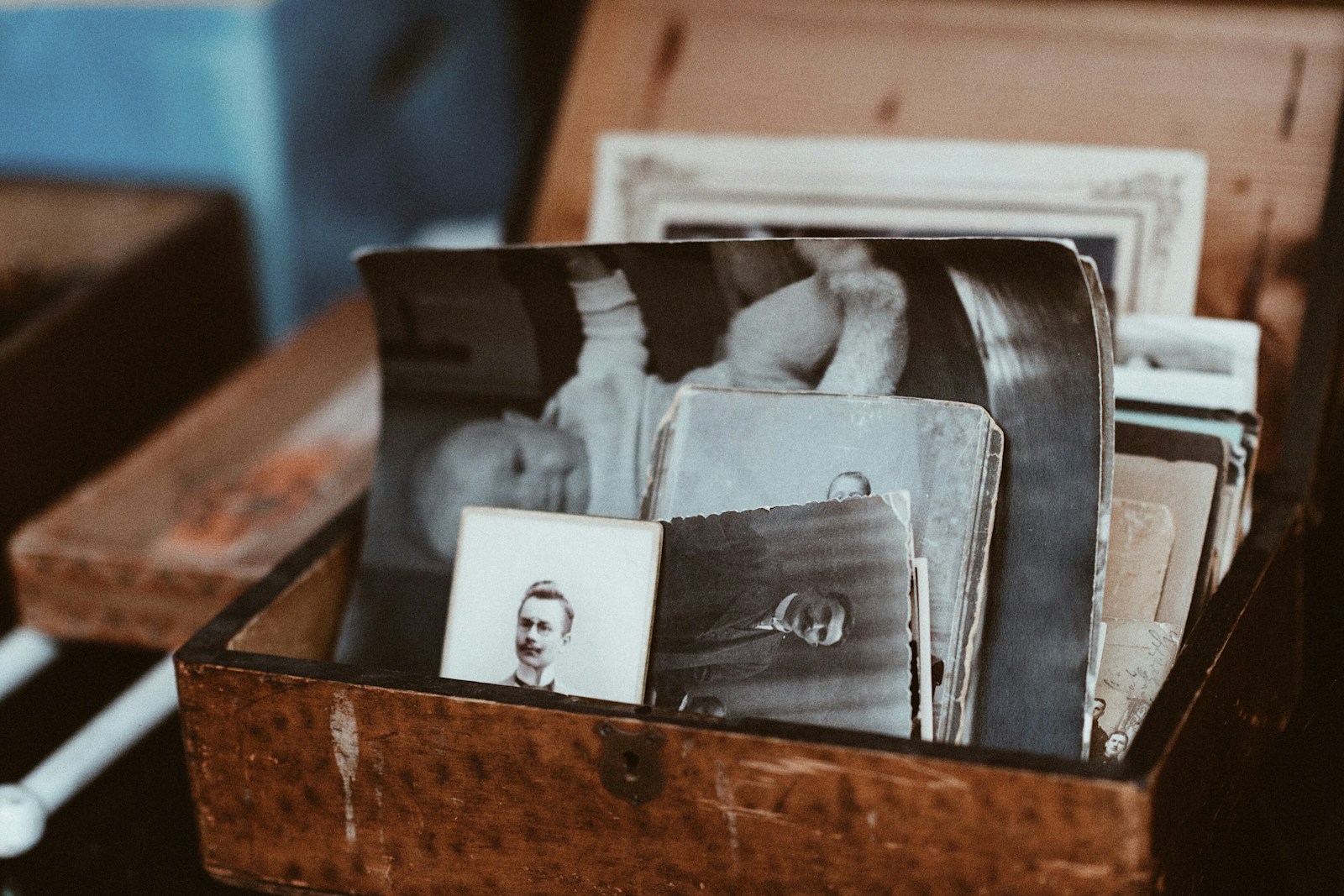

There is a particular kind of quiet that comes from opening an old box of photographs.
Not the crisp, edited digital images we scroll past today — but real, physical photographs. Glossy edges, slight curls, fingerprints from hands that may no longer be here. We keep them tucked away in spare-room cupboards, in see-through sandwich bags, in shoeboxes that once held something practical but now contain something far more precious: fragments of our lives.
And yet, if we’re honest, many of those photographs tell us very little.
A faded landscape. A birthday cake whose year we can’t remember. Someone we think was a neighbour. A smiling face we recognise but cannot place.
Time softens everything.
Even the moments we once believed we’d never forget.
The Keepers and the Forgettables
Some photographs are simply… there.
Snapshots taken because the camera was new, or because everyone felt they should document life, or because film was cheap that day. These images don’t hold meaning anymore. They’re not unimportant, exactly — just unanchored. Detached from the story that once gave them life.
And then, there are the others.
The ones we return to.
A grandmother’s delighted smile in her garden.
A group of women stretched out on towels at the seaside in the 1950s, sun-warmed and carefree.
Children barefoot on a lawn, hands sticky with melted lollies.
Ink-black and white photographs of weddings, christenings, homecomings.
Moments where the emotion is unmistakable.
We don’t keep those photographs because they’re visually perfect.
We keep them because they are part of who we are.
And sometimes — part of who we will become.
But Here Is the Problem
A photograph can show what happened.
But it cannot tell us why it mattered.
Without the story, a picture becomes a puzzle.
A mystery handed down through generations —
faces without names, smiles without context, homes without history.
We inherit photo albums, but not the knowledge that animates them.
Someone once knew the story behind the photograph.
But if no one wrote it down —
the story fades with them.
And Sometimes, A Photograph Becomes the Story
In recent weeks, one particular photograph has been mentioned again and again in headlines.
A single image — a frozen moment — that has shaped debate, recollection, denial, explanation, and public opinion.
We don’t need to go into the details of it here.
The point is simply this:
A photograph holds power.
It can preserve memory.
It can challenge memory.
It can reshape legacy — for better or for worse.
But very often, it leaves us with questions.
Where were they?
What was happening?
Why does it matter so much now?
And how many other photographs — quietly sitting in private collections — could tell extraordinary, gentle, everyday stories… if only someone had added a sentence or two?
The Photographs Worth Saving
Not all photographs need saving.
Some can be released.
We are not archivists of every moment.
But there are photographs that are worth the room they take up in our lives.
They’re the ones that:
Capture a first — a first home, a first love, a first step into adulthood.
Reveal a truth — the way someone laughed, or held themselves, or looked at the people they loved.
Mark a turning point — a departure, a return, a reunion, an awakening.
Anchor a family story — the kind that gets told at weddings and wakes.
And we know these photographs when we see them.
There’s a tug.
A warmth.
A yes — this mattered.
But Meaning Fades Without Words
The photograph alone cannot hold the story.
That’s why it is worth taking a moment — a small one, no essays required — to write a note that explains:
Who is in the picture
When and where it was taken
And most importantly — why this moment mattered
Not for publication.
Not for display.
Just as a gift to the future.
Because someone, one day, will pick up that photograph.
And they will want to understand what they are holding.
A Small Note Can Save an Entire History
You only need a few words to keep a memory alive.
Choose one photograph that matters, and write a short note to explain its story — who was there, what was happening, and why it still means something now.
It doesn’t have to be perfect. It just has to be there.
Because a photograph is what we keep.
But the story is what we pass on.