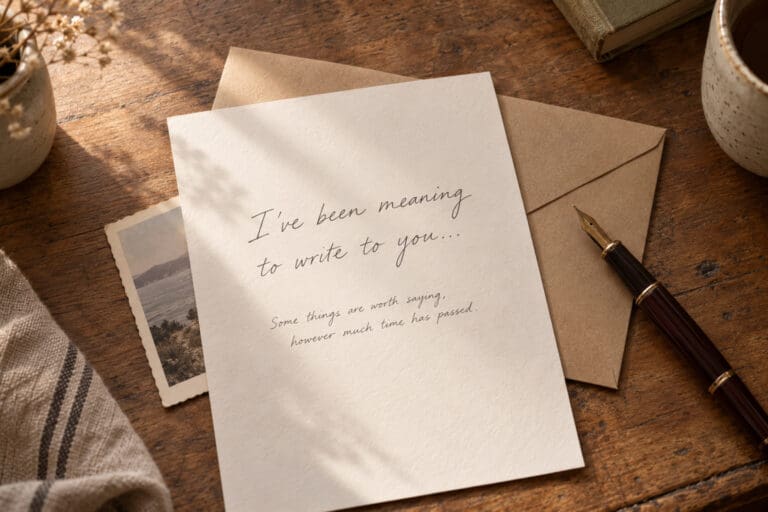
A place to leave the words that matter
There are times in life when the hardest thing isn’t knowing what you feel.
It’s finding the right moment, or the right way, to say it.
And there are other times when the problem is simpler and sadder.
You can’t speak.
You’re not well enough.
You’re not emotionally ready.
Or you’re simply not here.
For When I’m Not Here exists for those moments.
It isn’t a journal in the traditional sense.
There’s no routine, no target, no pressure to write every day.
It’s a place to leave words behind, carefully and thoughtfully, so they can be found later.
Words that explain.
Words that reassure.
Words that soften things for the people you love.
Not just for the end
Despite the name, this isn’t only about death.
Sometimes “not here” means:
- you’re unwell or recovering
- you’re struggling to communicate clearly
- emotions are running too high for the right words
- you need time to think before speaking
- you’re afraid of saying the wrong thing
- you want your words to land gently, not in the heat of the moment
Writing gives you space to say things as you really mean them, without interruption, misunderstanding, or pressure.
You don’t have to be facing the end of life to want that.
A place to speak when you can’t
Many of us carry important things inside us for years.
Thoughts we mean to say one day.
Explanations we never quite get around to.
Reassurances we assume are understood, but may not be.
For When I’m Not Here gives those words somewhere safe to go.
You might use it to:
- explain decisions you’ve made
- share what mattered most to you
- leave letters for specific people
- offer comfort for difficult days
- set down practical things in a human way
- say thank you, or sorry, or I love you, properly
There’s no expectation to fill every section.
Some people write one page.
Others come back over time.
Both are enough.
Why writing matters
Spoken words disappear.
Written words remain.
That doesn’t mean they have to be perfect.
In fact, the power of writing often lies in its imperfection.
Handwritten or typed, planned or spontaneous, these words carry your voice.
They sound like you.
They reflect who you were at the time you wrote them.
For the person reading them later, that matters more than polish.
Notes, not instructions
This isn’t about telling people what to do.
It’s about leaving behind:
- perspective rather than advice
- reassurance rather than rules
- presence rather than control
That’s why the language throughout is gentle and optional.
You can write in full sentences, fragments, or lists.
You can use the starter lines, change them, or delete them entirely.
Nothing here needs to be followed.
It’s simply offered.
Keeping and sharing your words
Some people keep everything they write here entirely private, and that’s absolutely fine.
Others choose to save or share their words in ways that feel right for them, either now or in the future.
You might choose to:
- download everything and save it digitally, somewhere safe
- print it, so it exists as something tangible
- store it with other important documents
- keep a copy on a personal device or drive
- let someone you trust know it exists, without sharing it yet
There’s no single right way to do this.
What matters is that your words are kept in a way that feels secure and considered.
Alongside a will, not instead of one
Many people choose to mention For When I’m Not Here alongside a will or power of attorney.
Not because it’s legal, but because it’s personal.
A will deals with assets and arrangements.
This is where you speak in your own voice.
Some people choose to:
- reference it in their will
- note where a printed or digital copy can be found
- explain who should have access, and when
The two can sit side by side, doing very different jobs.
For the people who read it later
For those who come across these words in the future, the value is often unexpected.
It might be:
- comfort on a difficult day
- clarity where there was confusion
- reassurance where guilt might otherwise grow
- a sense of connection, even after loss
Often, it’s simply the relief of knowing:
“This is what they wanted me to understand.”
That alone can be a gift.
There is no right time to start
People often think they need a reason to begin something like this.
A diagnosis.
A milestone birthday.
A moment of crisis.
In truth, the best time is usually quieter than that.
When things are calm enough to think.
When you have the space to choose your words.
When you can write without urgency.
You don’t need to finish it.
You just need to begin.
Leaving words is an act of care
Writing things down isn’t about being pessimistic.
It’s about being thoughtful.
It’s about recognising that communication matters, even when life makes it difficult.
For When I’m Not Here is a place to do that, gently and honestly.
A place to leave the words that matter.